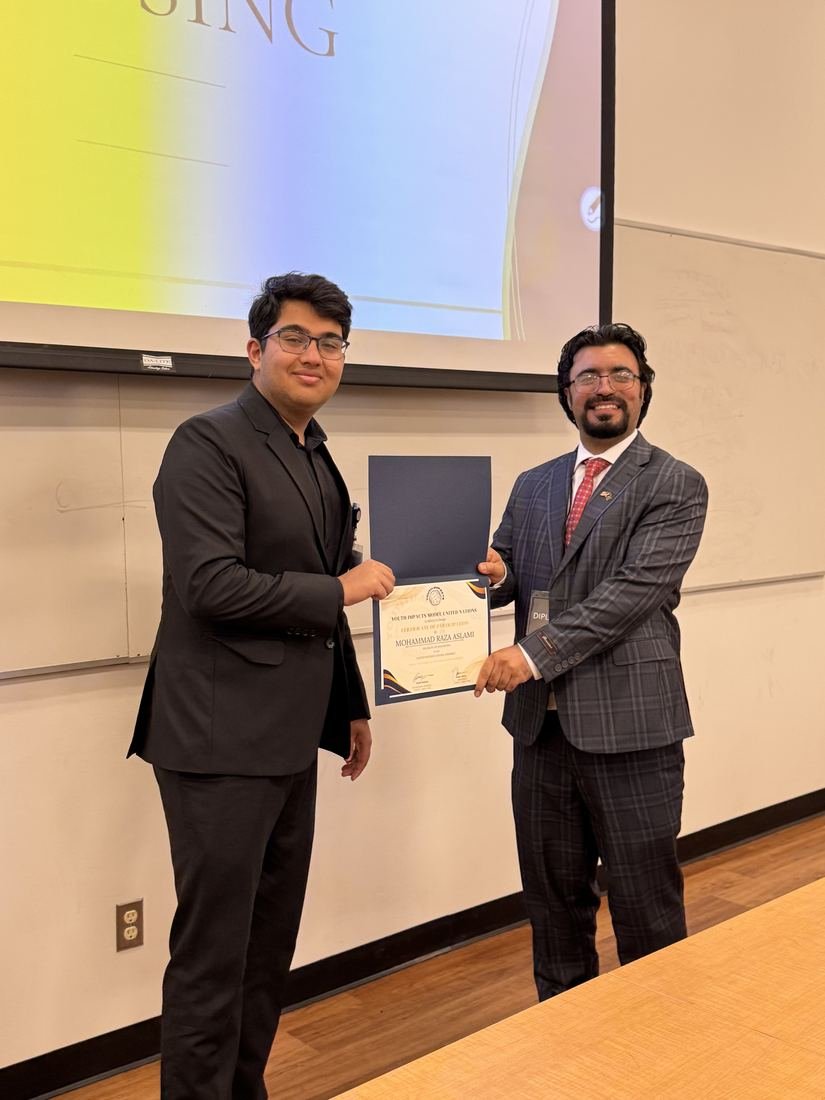
If you are a Pakistani parent considering an international Model UN conference for your child, the question on your mind is not abstract. It is concrete and reasonable: will spending PKR 800,000 to 1.5 million on a single trip actually change my child's chances at LUMS, NUST, IBA, GIK, Oxford, MIT, or Wharton?
You deserve an honest answer rather than a marketing one. The honest answer is this: international conference experience helps admissions outcomes, but the way it helps is more nuanced than most brochures suggest. How a student does Model UN matters far more than how many conferences they attend. A delegate with depth — committee leadership, an award or two, a sustained two- or three-year arc, and a written reflection that actually says something — reads stronger to admissions officers than a delegate with five conference badges and no narrative thread connecting them.
This piece walks through how admissions committees in Pakistan, the UK, and the US actually evaluate extracurricular activities, what MUN specifically signals to those committees, where the risks of overdoing it lie, and how to convert conference experience into application material that holds up under scrutiny. We'll mention PIFIS only where it's directly useful; the rest is process.
How admissions officers actually evaluate extracurriculars
The most common misconception is that admissions is a tally — that more activities mean a stronger application. At competitive universities, the opposite is closer to the truth. Officers at Stanford, Yale, Oxford, and increasingly LUMS are looking for spikes, not spreads: depth in one or two areas that suggests genuine talent or commitment, rather than thinly distributed effort across ten clubs.
If your child plays cricket competitively at the regional level, tutors younger students every Saturday, and has chaired three Model UN committees, that profile communicates something. If they have done a little of fifteen things, it communicates something else — and not what you want.
The Common Application activities list
For US applications, the Common App offers ten activity slots. Students rank them by importance, and each slot includes the activity name, position held, hours per week, and weeks per year. Officers spend, on average, six to eight minutes on the entire application. They scan the activities list quickly. The first two or three activities carry disproportionate weight.
For a serious MUN delegate, the activities list might list "Model UN — Delegate, Chair, Head of Delegation" as the top entry, with quantified hours: 6 hours per week during conference season, 40 weeks per year, three years. Compare that to "Model UN — Member, attended 2 conferences" with 2 hours per week. The first describes a person; the second describes a participant.
Supplementary essays and the activities elaboration
The Common App also offers an "Additional Information" section and most US universities require supplemental essays — Why This Major, Why This School, an Activities Detail prompt, or a short Leadership essay. Each is a chance to make Model UN do real work in your application, rather than sitting as a line item. We'll come back to how to write these in a later section.
The recommender letter
One asset that international MUN unlocks, and which Pakistani parents often overlook, is a letter from a chair, faculty advisor, or conference director. A two-page letter from a Harvard MUN chair or a Best Diplomats secretariat member, describing how your child handled a difficult crisis committee or led a deadlocked unmoderated caucus, is exactly the kind of third-party endorsement that admissions committees take seriously. School teachers know your child as a student. A conference chair has seen them under pressure, debating policy with strangers from Lebanon, Indonesia, and Brazil. That perspective is rare and valuable.
What MUN actually demonstrates to admissions committees
When an admissions officer sees Model UN on an application, here is what they read into it — assuming the student has done it seriously.
Public speaking competence
Most 17-year-olds cannot speak unscripted to a room of 80 strangers for 90 seconds without freezing. A delegate who has done this dozens of times — in moderated caucuses, opening speeches, GSL slots — has a skill that is rare in any applicant pool. Admissions officers cannot test it directly, but they can infer it from sustained MUN involvement.
Geopolitical literacy
A student who can speak credibly about the Treaty on the Non-Proliferation of Nuclear Weapons, the Sustainable Development Goals, the Saudi-Iran rapprochement, or the structure of the WTO appellate body signals that they read the world. For applicants to International Relations, Politics, Public Policy, History, and Law programs, this matters enormously. For a Pakistani applicant in particular, it counters the (unfair but real) assumption that South Asian applicants are technically strong but globally narrow.
Negotiation and consensus-building
This is the part of MUN that doesn't make it into highlight reels. Drafting a working paper with seven other delegates whose countries have incompatible interests, then merging two competing drafts into a single resolution that passes — this is core leadership work. Admissions committees know the difference between someone who can talk and someone who can build something with a group of people who don't initially agree. The second is much rarer.
Written argumentation
Position papers, working papers, draft resolutions, and operative clauses are real writing. A two-page position paper on Pakistan's stance regarding Kashmir at a Security Council simulation, or a resolution clause negotiating a global minimum tax at an ECOSOC committee, is the kind of structured argumentative writing that admissions readers prize. If your child has been writing position papers for three years, their personal statement will read sharper than a peer who has not.
Sustained commitment
A two- or three-year arc — Year 9 first delegation, Year 10 international conference, Year 11 chairing position, Year 12 head of delegation — tells a story. A single conference does not. Officers are skeptical of one-shot extracurriculars, especially expensive ones, because they read like resume-padding. Sustained commitment does the opposite work: it signals that the student does this because they want to, not because their parents bought them a slot.
International exposure
For Pakistani applicants applying to US, UK, Canadian, or Australian universities, an international MUN record carries specific weight. It signals that the student has interacted with peers from 50 or 80 countries; has navigated visa processes, foreign airports, and unfamiliar cultural settings; has held their own in English-language committee debate against students from Singapore, the UAE, and the United States. For an applicant who otherwise has limited foreign travel, this can shift the read of the entire profile.
The Pakistani context: how local universities evaluate this
If your child is applying domestically, the rules differ from US and UK admissions. Here's an honest summary.
LUMS, IBA, GIK, FAST, NUST
For undergraduate admissions to LUMS (especially the MGSHSS programs — Economics, Political Science, Sociology, Anthropology), extracurriculars and the personal essay carry real weight alongside academic results. The LUMS application historically asks for an essay and lists of activities, and Model UN with sustained involvement is a recognized credential. For IBA Karachi, especially the BBA program, the SAT/aptitude test and high school grades dominate, but the interview round considers communication ability and leadership — both of which MUN sharpens directly. NUST and GIK weight engineering aptitude tests and FSc grades most heavily; extracurriculars play a smaller but non-zero role, especially for borderline candidates. FAST is similar.
The pattern: Pakistani business and liberal arts programs reward Model UN more than engineering and medical programs do. An LUMS Economics applicant gains more from MUN than a NUST Mechanical Engineering applicant.
Oxford, Cambridge, LSE
UK admissions are subject-specific and academic. Oxford does not look at activities lists the way US universities do. Your A-Level or IB grades, admissions test scores (LNAT for Law, TSA for PPE, MAT for Maths), and personal statement decide most of it. But the personal statement is where MUN becomes useful. For PPE, Law, History, International Relations, HSPS at Cambridge, or LSE's social science programs, a personal statement that draws on a specific Security Council debate or a position paper you wrote about WTO dispute resolution can show genuine intellectual engagement with the discipline. The trick is that UK personal statements are rigorously academic — you cannot just talk about how MUN was inspiring; you have to use it to demonstrate how you think.
US universities
US admissions are holistic. Activities, essays, recommendations, grades, and test scores all weigh together. For top-30 US universities, MUN is a recognizable credential that pairs especially well with intended majors in Political Science, International Relations, History, Economics, Public Policy, and Law (for Pre-Law tracks). It also pairs surprisingly well with Computer Science or Engineering, where committees look for evidence that a future engineer can communicate, lead, and operate beyond their technical bubble.
Yale-NUS, NYU Abu Dhabi, Sciences Po, Minerva
For globally oriented liberal arts programs — Yale-NUS in Singapore, NYU Abu Dhabi, Sciences Po in Paris, Minerva, Ashoka in India — international MUN experience signals the exact disposition these programs select for. These admissions committees are explicitly looking for cross-culturally fluent students who have already operated in international settings. A Pakistani applicant with two or three Best Diplomats or NMUN conferences has a credible case to make at these schools.
If you're comparing what those international conferences actually involve, our explainer on the Best Diplomats format and judging goes deeper into committee structure and award criteria.
The risk of overdoing it
There is a phenomenon in admissions reading that experienced officers refer to as "leadership inflation." It is now common for applicants — particularly from South and East Asia, where the college admissions arms race is most intense — to list every conference, every club, every workshop in a way that makes the activities list look impressive at first glance and meaningless on closer inspection.
An applicant who lists eight Model UN conferences, "Founder of the MUN Society," "Founder of the Debating Club," "Founder of the Public Speaking Forum," and "President of the International Affairs Society" — all in one school — does not look like a leader. They look like someone whose parents organized the appearance of leadership. Officers at top US universities read 30,000 to 60,000 applications a year. They notice patterns.
The corrective is unfashionable but true: three thoughtful conferences with clear growth — beginner committee in Year 10, regional Best Diplomats in Year 11, chairing role in Year 12 — beats ten conferences with no narrative. Admissions readers can recognize a real arc. They can also recognize when an arc has been manufactured.
For a longer treatment of how a delegate's progression actually unfolds — from first GA committee to chairing — see our piece on the novice-to-chair journey.
How to write about your MUN experience
The activities list and the essay do different jobs. The activities list is data; the essay is voice. Here is how to use each.
Don't list awards. Tell a moment.
"Best Delegate at HMUN 2025" is a credential, but it is not an essay. The essay is what you do with it. The strongest MUN essays focus on a single specific moment: a tense unmoderated caucus where the German delegate and the Russian delegate were not talking, and you walked across the room to broker a side deal that became the basis of the operative clauses. A position paper draft you abandoned at 1 a.m. and rewrote because you realized your country's actual policy was the opposite of what you'd argued. A topic — say, the militarization of Antarctica or the right-to-be-forgotten under the GDPR — that genuinely changed the way you think about something.
Specificity is everything. Officers read 25 essays before yours. They will not remember "I learned the importance of teamwork." They will remember "the moment I realized the Brazilian delegate's amendment was actually stronger than my own bloc's, and I had to choose between defending my draft and supporting hers."
Connect MUN to your intended major
This is the move that separates the strong essays from the average ones. The IR student who writes about a Security Council debate on hybrid warfare has connected an extracurricular to a discipline. The future law student who writes about drafting a resolution clause on extraterritorial jurisdiction has done the same thing. The public health applicant who writes about a WHO simulation on antimicrobial resistance has done it again. The connection is the work.
If you are applying for Computer Science and your essay is about MUN, find the bridge: maybe it's a UNESCO committee on AI governance, or an ECOSOC debate on cross-border data flows. The bridge has to be real, but it almost always exists if you look for it.
Avoid clichés
The phrases that sink MUN essays are familiar: "I learned the importance of teamwork." "MUN taught me to be a leader." "I gained confidence in public speaking." "I was exposed to different cultures." These sentences could be written by anyone. Cut them. The version of the essay that survives is the one with a specific scene, a specific decision, a specific change in your own thinking.
A realistic delegate-to-admissions trajectory
Here is what a credible four-year arc looks like for a student whose family is genuinely investing in international MUN as part of a broader admissions strategy.
| School year | Activity | Goal |
|---|---|---|
| Year 9 (Grade 9) | 1–2 local Pakistani MUNs (LUMUN, KGSMUN, BeaconhouseMUN) | Learn the format, get over speech anxiety, find which committee types you like |
| Year 10 (Grade 10) | 2–3 local conferences, 1 regional or international (Best Diplomats Dubai, NMUN, IMUN) | Start building international resume, attempt your first position paper award |
| Year 11 (Grade 11) | 1–2 international conferences, apply for chairing positions at school MUN, attempt crisis committee | Secure 1–2 awards (Best Delegate, Best Position Paper, Outstanding Diplomacy) |
| Year 12 (Grade 12) | 1 flagship international conference; head of delegation role; recommender letter conversation | Form the narrative for your application — 2–3 conferences with a clear progression |
This is not the only valid path. A student who discovers MUN late and does two strong international conferences in Year 12 with depth and reflection can still write a compelling application. But the four-year arc is the cleanest version of the story, and it's what we see work most reliably in our cohorts.
If you're newer to all of this and want to start from first principles, our guide to Model UN for Pakistani students and parents is the right starting point.
The honest summary
International MUN experience helps with college admissions. It does not guarantee anything. It is a credential that, paired with strong grades, a thoughtful essay, and genuine sustained involvement, can move an application from competitive to compelling. It will not rescue a weak academic record, and it will not substitute for clear writing.
The students whose admissions outcomes change because of MUN are the ones who treated it as a serious commitment rather than a checklist item — who read about the topics, wrote real position papers, took chairing roles, and could speak about their experience with specifics rather than slogans. The investment is significant; the return is real but not automatic. Treat it that way and the math usually works.
Frequently asked questions
Does MUN matter for medical school admissions in Pakistan?
For Pakistani medical schools, the entrance exam (MDCAT) and FSc grades are decisive. Extracurriculars carry far less weight than for business or liberal arts programs. MUN can still help marginally for Aga Khan University's interview, where communication and ethical reasoning are tested, and for any US or UK medical pathway. But no parent should fund international MUN purely to strengthen an MBBS application in Pakistan.
How many MUNs is enough for a strong college application?
There is no fixed number. Three to five conferences across two to three years, with at least one international event and ideally one award or chairing role, reads as serious involvement. Ten conferences with no leadership, no awards, and no growth narrative reads as a checklist exercise. Depth beats volume.
Will admissions officers know what "Best Delegate at HMUN" means?
Officers at top US, UK, and Canadian universities recognize Harvard MUN, NMUN, WorldMUN, and similar flagship conferences. For lesser-known regional events, you should briefly contextualize the award in your activities description, e.g., "Best Delegate, Security Council, 80-delegate committee, judged by Harvard alumni panel". Don't assume; explain in one line.
Is one prestigious conference better than three smaller ones?
Usually yes, if the prestigious conference produced real depth, an award, or a written reflection you can draw on for essays. But two or three conferences across different formats, with visible progression from delegate to chair or from beginner committee to crisis committee, can outperform a single high-profile event with no follow-through.
Should I list MUN if I only attended one conference?
Yes, if it genuinely shaped you and you can write about it specifically. A single conference is honest. What weakens an application is listing one MUN and exaggerating it as "sustained leadership in international affairs". Honesty about scope, paired with a sharp reflection, is stronger than inflation.
Planning your delegate's admissions arc?
PIFIS works with families building two- and three-year MUN trajectories ahead of LUMS, US, and UK applications. Talk to us about Youth Impacts 2026 or our upcoming international delegations.
Get in touch