If you've heard the words Model UN floating around your child's school WhatsApp group, on a Beaconhouse notice board, or from a friend whose son just came back from a conference in Dubai, you probably already have a fuzzy sense of what it is — students in suits, debating something serious, sometimes overseas. This guide is the version we wish more Pakistani families had before they made decisions about it.
Model United Nations is a structured simulation in which secondary-school and university students take on the role of delegates representing countries other than their own, sit in committees that mirror the actual organs of the United Nations, and try to solve real-world problems through debate, negotiation and the drafting of resolutions. A Pakistani student might spend three days representing Brazil on the disarmament committee, or France on the Human Rights Council, or — in a crisis committee — Maximilien Robespierre during the French Revolution. The fiction is that you are someone else; the work is unmistakably your own.
It is one of the most credible extracurricular pathways available to Pakistani teenagers today, and one of the most misunderstood. Below, we'll walk through what MUN actually is, how it works, the vocabulary that confuses everyone at first, why it matters for university admissions, the cultural questions Pakistani Muslim families ask, and what a delegate's first international conference actually feels like.
The basic format: what happens inside an MUN committee
An MUN conference typically runs over three to five days at a university or hotel venue. Each delegate is assigned a country and a committee months in advance. They are also given a list of topics — usually two — that the committee will debate. A delegate's job, before they ever step into the room, is to research their country's foreign policy on those topics and submit a position paper explaining what their country believes and what it wants the committee to do.
Once the conference begins, a chair (a senior delegate or academic) opens the committee. There is a roll call. Speeches happen. Negotiations happen — sometimes in the formal seating of the committee room, often in the hallway, in the lunch queue, or scribbled across notepads passed between delegates. By day three, blocs of countries that share interests have drafted working papers. By the closing session, those have been sharpened into draft resolutions that the committee votes on. The delegates whose work and diplomacy stood out — not necessarily the loudest in the room — win awards.
That, stripped of mythology, is what Model UN is.
The committee types you'll encounter
Not all MUN committees feel the same. Broadly, they fall into three categories.
General Assembly committees
These are the largest, often 80 to 200 delegates. Topics are global and procedural — disarmament, sustainable development, education, refugees. Speeches are short, blocs are big, and resolutions tend to be broad. DISEC (Disarmament and International Security), SOCHUM (Social, Humanitarian and Cultural) and SPECPOL (Special Political and Decolonization) are common GAs and are usually where first-time delegates start. They are forgiving for beginners and excellent for learning the rhythm of debate.
Specialised agencies and ECOSOC bodies
Smaller — typically 30 to 60 delegates — and more technical. The UN Security Council (UNSC) is the most coveted: only 15 seats, only the five permanent members (the P5: US, UK, France, Russia, China) hold veto power, and topics are usually live geopolitical crises. The Human Rights Council (UNHRC), WHO, ECOSOC, UNEP, IAEA and the Commission on the Status of Women all sit here. Specialised agencies reward depth — you need to know your country's actual position, not just improvise.
Crisis committees
The fastest-paced, most theatrical form of MUN. Delegates represent individual people — cabinet ministers, generals, historical figures, fictional characters — rather than countries. A backroom team of "crisis staff" injects breaking news every hour: a coup, an assassination, a pandemic. Delegates respond in real time through directives (private actions a character can take) and communiqués (messages to outside actors). Crisis is unforgiving and unforgettable. It's also where many of the strongest delegates eventually end up.
The vocabulary, demystified
The first MUN you walk into will be loud with jargon. Most of it is straightforward once translated.
| Term | What it actually means |
|---|---|
| Delegate | You. The student representing a country or character. |
| Position paper | A 1–2 page pre-conference essay outlining your country's stance on the topic. Usually due 1–2 weeks before the conference. |
| Moderated caucus | A structured debate on a sub-topic. Each delegate speaks for a fixed time (usually 60–90 seconds) when called by the chair. |
| Unmoderated caucus | An informal break in which delegates leave their seats, form blocs, and negotiate. This is where most of the real work happens. |
| Working paper | An early-stage document outlining proposed solutions. Multiple working papers usually exist before they merge into draft resolutions. |
| Draft resolution | The formal proposal a bloc submits for the committee to vote on. Written in UN format with preambulatory and operative clauses. |
| Voting bloc | A group of countries with shared interests negotiating together — for example, the African Union bloc, the EU bloc, or the OIC bloc. |
| P5 | The five permanent members of the Security Council with veto power: the US, UK, France, Russia and China. |
| Point of order | A formal interruption to flag a procedural mistake (e.g. the chair miscounted a vote). |
| Point of inquiry | A polite question to the chair about how the rules work. |
| Yields | What you do at the end of a speech with leftover time — yield to the chair, to questions, or to another delegate. |
You'll pick this up faster than you think. By the second day of your first conference, the language is muscle memory.
Why MUN exists, and what it actually builds
Model UN began in the 1920s as a Model League of Nations and migrated to the United Nations after 1945. The point was never to produce diplomats. It was to give students a serious, structured environment in which to wrestle with real questions about how the world is organised — and to do so with people whose views and contexts are not their own.
Done seriously, MUN builds a specific cluster of skills that few other school activities target together:
- Public speaking under pressure — not in front of friends, but in front of strangers, on topics where you can be challenged.
- Research literacy — reading UN resolutions, treaty texts, country reports, and synthesising them quickly.
- Negotiation — finding language that two countries with opposing interests can both live with.
- Written argumentation — position papers and resolutions are exercises in compressed, formal writing.
- Geopolitical literacy — by your fourth or fifth conference, you genuinely understand how the world's blocs work, which is rarer than it should be.
It is, in our experience, one of the very few extracurriculars where the quiet, thoughtful student often outperforms the obviously-confident one. MUN rewards preparation.
How MUN took root in Pakistan
Pakistan's MUN scene is younger than people assume but has grown quickly. LUMUN — the Lahore University of Management Sciences Model United Nations — held its first edition in 2003 and is widely regarded as the country's flagship conference. It now hosts well over a thousand delegates each year, with secondary-school and university tracks running in parallel.
From there, the circuit broadened. LSEMUN at Lahore School of Economics, IBA-MUN at IBA Karachi, FCCU MUN, NUSTMUN in Islamabad, and the Beaconhouse, City School and LGS school-circuit conferences run a near-continuous calendar between September and April. By the time a Pakistani student finishes A-Levels, it's not unusual for them to have attended six to ten conferences locally.
That's the launch pad. The international leap is a different conversation.
The leap from Pakistan to international conferences
A delegate who has done well at LUMUN is not automatically ready for an international conference, and pretending otherwise sets students up for a discouraging first trip. The format is the same. The intensity is not. Three things change.
Committee size and depth. A General Assembly at HMUN Boston or WorldMUN can carry 250 delegates. The competition for speakers' time is fiercer, and chairs are stricter about substantive content. Delegates who relied on charm at home find that international chairs want sourced, specific arguments.
Delegate diversity. At a Pakistani MUN, most delegates share the same education system, the same news sources, often the same political instincts. At Best Diplomats Dubai or HMUN Beijing, you're negotiating with delegates from 60–95 countries — Nigerian students who actually know AU politics, Latin American delegates who have lived through hyperinflation debates, Eastern European delegates whose grandparents remember the Cold War in detail. The conversation gets harder and more interesting at the same time.
Judging standards. International chairs reward different qualities than local circuits sometimes do. Loudness loses to clarity. Showmanship loses to negotiation. Repetition loses to fresh, sourced contributions. A delegate who has won several school awards at home should expect their first international conference to be humbling — and that's the point.
If you're starting to think practically about that leap, our companion guide on how to prepare for your first international MUN walks through the full ten-week preparation arc, from country selection to position paper feedback rounds.
Who benefits most from MUN
MUN is not for everyone, and we'd rather be honest about that than oversell it. The students who get the most out of it tend to share three traits:
- Global curiosity. They read the news without being asked. They have opinions on Gaza, Kashmir, Ukraine, Sudan — even half-formed ones. They want to understand why the world is the way it is.
- Patience with research. The student who can sit with a 40-page UN report and pull out three useful arguments will outperform the student who walks in confident but unprepared, every time.
- Willingness to be uncomfortable. The first speech you give in an international committee will be terrifying. The students who lean into that discomfort, rather than retreating from it, are the ones who grow.
We see two groups especially flourish. Future law, public-policy, international relations and political-science aspirants get a real preview of what those disciplines feel like in practice. And — this surprises parents most often — quiet, bookish students who would never volunteer in class often turn into the strongest delegates by their third or fourth conference. MUN gives them a structured environment where preparation matters more than personality.
Common myths Pakistani parents and students believe
Myth 1: You need a debate background. You don't. MUN and competitive debating overlap in obvious ways, but they reward different skills. Debaters often have to unlearn habits — over-aggression, point-scoring, dismissiveness — that don't serve them in committee.
Myth 2: Your English has to be perfect. It doesn't. Clear, structured English with a Pakistani accent is fine. Chairs want delegates who can think, not delegates who sound like BBC presenters. We've seen delegates with imperfect grammar win Best Delegate awards because the substance of what they were saying was sharper than anyone else's.
Myth 3: You have to be the loudest in the room. The most consistently-awarded delegates we know are not the loudest. They are the ones who speak less but more usefully — who write the resolution everyone signs onto, who broker the compromise between two stuck blocs, who quietly become indispensable.
Myth 4: It's only for elite-school students. Most international Pakistani delegations skew Beaconhouse, LGS, KGS and the like, but the gates aren't actually closed. We have placed delegates from FAST, public colleges, and smaller cities. What matters more is preparation and seriousness.
What a Pakistani delegate's first international conference actually looks like
You land in Dubai or Kuala Lumpur or Bangkok the day before opening ceremony, jet-lagged and over-caffeinated. There is a delegation briefing that evening. You meet your committee chair the next morning at registration — they hand you a placard with your country's name and a folder of materials.
The opening session is largely procedural — roll call, agenda-setting, opening speeches in alphabetical or randomised order. You'll deliver yours within the first two hours, and afterwards you'll feel like the floor wobbled slightly. It didn't. By the second moderated caucus, you're tracking which delegates seem to be forming blocs around your position. By the lunch break, you're in a corner of the hotel lobby with three other delegates sketching the bones of a working paper on the back of a napkin.
Day two is when committee accelerates. You'll feel the pressure to contribute substantively — to introduce a clause, to propose a friendly amendment, to broker a merger between two competing working papers. You will probably be tired. You will eat dinner with your delegation and laugh more than you expected.
By day three, you're voting on draft resolutions. Some pass, some fail, and the chair makes a closing speech. There's a closing ceremony, often a gala dinner, awards. Whether or not your name is called, you will go back to your hotel room knowing — in a way you didn't before the trip — what you are capable of in a room full of strangers.
That experience, repeated across two or three international conferences, is what gives the MUN line on a university application its real weight. Our deeper analysis on why college admissions officers value international conference experience goes into what specifically signals strength to Ivy League and Russell Group reviewers.
Cultural notes for Pakistani Muslim families
This part of the conversation matters, and we'd rather have it openly than gloss over it. Pakistani families sending teenagers to international conferences ask three questions consistently. Here's what we've learned across our delegations.
Halal food
At conferences in the UAE, Malaysia, Turkey, Indonesia and the Maldives, halal is the default. You don't have to ask. In the US, UK, most of Europe, and parts of East Asia, halal is available but requires planning. Reputable Pakistani delegation organisers — including PIFIS — coordinate halal meals through the venue, identify nearby halal-certified restaurants in advance, and brief delegates on what to ask at airline meal selection. Most major airlines now offer Muslim Meal (MOML) as a pre-bookable option.
Prayer time
Conferences in Muslim-majority countries usually pause for Maghrib and provide prayer rooms. In Western venues, prayer rooms exist at most major universities and convention hotels — Harvard, Yale, the major Boston and London hotels — and we make a point of identifying them on the orientation map. Delegates manage their own salah schedule around committee sessions, the same way they would in school.
Dress code, especially for female delegates
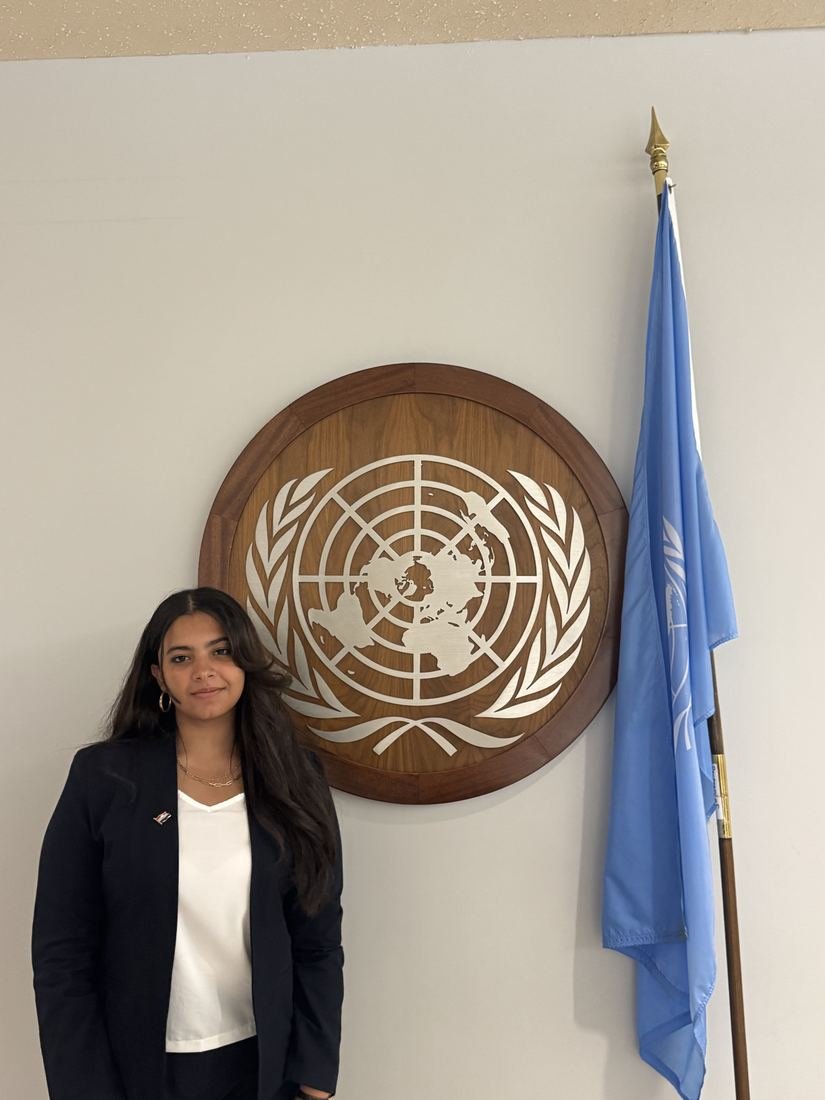
Western Business Attire is the standard at almost every international MUN: dark suits for men, formal trousers or skirt-suits for women. For female Pakistani delegates who wear hijab, this is straightforward — most international conferences have substantial Muslim representation and hijab is unremarkable in committee. Delegates wearing shalwar kameez or saris on cultural night (most major conferences have one) is positively encouraged. Slide 7 of our partnership brief, for context, shows a Pakistani delegate in traditional dress at the UN — that's a normal sight, not an exotic one.
Gender-mixed environments
Committees, hotel public spaces and conference dinners are all mixed. Hotel rooms are not — Pakistani delegations universally room same-gender, and chaperones travel with the delegation. We assume conservative norms by default and only adjust when families specifically opt for something different.
Frequently asked questions
Does my child need a debate background to do Model UN?
No. Most successful delegates we've worked with had no formal debating background. MUN rewards research, structured argument and the ability to negotiate — skills that are taught and practised through the conference itself, not pre-requisites for entry.
What age is appropriate to start Model UN in Pakistan?
Most students begin between ages 14 and 16, typically in O-Levels or matric. Some schools introduce junior MUNs from Class 7. International conferences generally accept delegates from age 14 upwards, with separate divisions for university-level participants.
Is Model UN useful for university admissions abroad?
Yes, when it's substantive. Admissions officers at competitive US, UK and Canadian universities recognise sustained MUN participation — particularly international conferences and committee awards — as evidence of intellectual curiosity, written communication and leadership. It is not a magic ticket, but it is a credible signal, and admissions offices have become better at distinguishing serious MUN delegates from one-off attendees.
Will halal food and prayer time be available at international MUN conferences?
At conferences in the UAE, Malaysia and Turkey, yes — halal is the default and prayer rooms are standard. In the US, UK and most of Europe, halal options exist but require planning. Reputable Pakistani delegation organisers, including PIFIS, build halal meals and salah accommodations into the itinerary by default rather than treating them as an afterthought.
How much does an international MUN cost from Pakistan?
All-inclusive packages from Pakistan typically range from PKR 800,000 to 1.5 million per delegate, depending on destination, hotel category and whether visas, flights, conference fees, accommodation and meals are bundled. Conferences in Dubai and Malaysia sit at the lower end; New York, Geneva and London at the higher end. Our companion piece on the 7 best international MUN conferences for Pakistani students in 2026 breaks down costs by conference.
What's the difference between a Pakistani MUN and an international one?
Local conferences like LUMUN, LSEMUN and IBA-MUN are excellent training grounds, but committee sizes, topic depth, judging standards and the diversity of delegates step up significantly at international conferences. The procedural format is the same; the intensity, the calibre of preparation expected, and the cultural mix of the room are not.
Thinking about your child's first international MUN?
PIFIS runs Pakistani student delegations to international conferences with halal, prayer and chaperone support built in. Talk to us about Youth Impacts 2026 or any of our upcoming delegations.
Get in touch