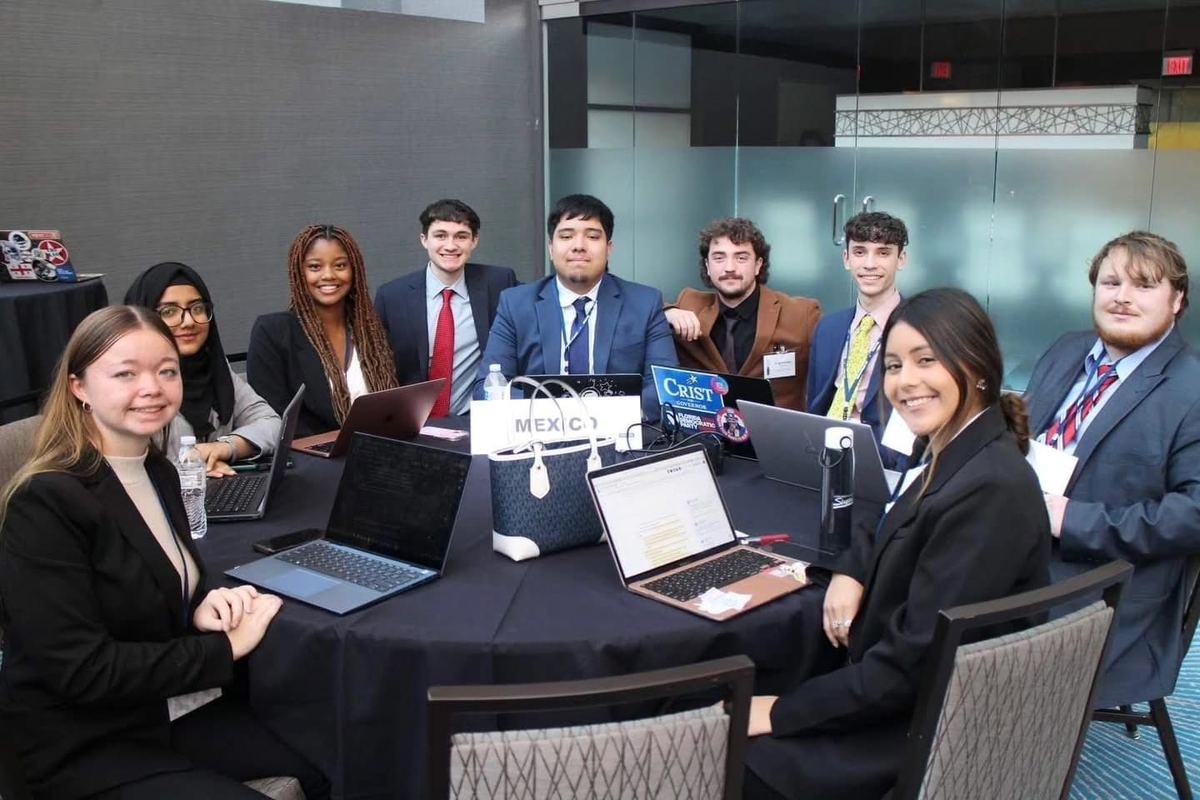
Your first international Model UN is not your fifth Lahore-circuit conference with extra flights. The room is bigger, the standards are higher, and the delegates next to you have often been preparing for two months. The good news: the gap between a strong Pakistani local-circuit delegate and a competitive international delegate is not talent — it is a few specific habits, applied over eight weeks. This is the playbook we wish someone had handed us before our first conference abroad.
If you're new to the format itself, start with our primer on what Model UN is for Pakistani students and parents. Everything below assumes you've done at least one or two local conferences and know the basics of caucuses, resolutions, and committee flow.
What's actually different about an international MUN
Three things change when you cross a border for a conference.
Committee size. A typical Pakistani school MUN runs committees of 20–35 delegates. International conferences like Best Diplomats, Harvard WorldMUN, or NMUN regularly run 80–150 delegates per committee. That changes everything: the speakers' list is longer, you may not get called for thirty minutes, and lobbying happens in clusters rather than one shared table.
Preparation depth. On the Pakistani circuit, a hastily-written one-page position paper can still earn a Best Delegate. At an international conference, the floor for a serious delegate is a 1.5-page paper with real citations, knowledge of three to four recent UN resolutions on the topic, and an internalised foreign policy position. Delegates from European model UN societies often arrive with shared Drive folders and rehearsed bloc strategies.
Judging standards. International chairs are typically university students or alumni who have judged dozens of committees. They penalise the things Pakistani circuits sometimes overlook: speaking out of character (representing your personal opinion instead of your country's), vague solutions, factual errors about your country's actual policy, and disrespectful conduct toward other delegates.
The 8-week preparation timeline
Country allocations usually drop 6–10 weeks before the conference. Treat allocation day as the start of your training programme. Here's how the weeks should look.
8 weeks out: foundations
- Read your committee's official background guide cover to cover. Highlight every term you don't recognise. Look each one up.
- Build a one-page country brief for yourself: capital, head of state, GDP, key alliances, current foreign minister, recent UN voting behaviour, and one or two foreign-policy red lines.
- Identify the committee. UNSC, UNHRC, ECOSOC, DISEC, WHO, and crisis committees all have different rules of procedure and different judging emphases. Read your conference's rules document.
- If your country has a permanent UN mission with a public website (most do), bookmark it. You will return to it weekly.
4 weeks out: research and position paper
- Finish a first draft of your position paper. We cover the format below.
- Read three recent UN resolutions on your topic. Note which countries voted yes, which voted no, and which abstained — that's your bloc map.
- Identify three to five "natural ally" countries based on voting record. These are the delegates you'll lobby first.
- Practise reading your position aloud. If you can't say it without stumbling, rewrite it.
2 weeks out: speeches and rehearsal
- Write your General Speakers List opening speech and rehearse it three times in front of a mirror or a sibling. Time it. Aim for 60–90 seconds.
- Write a "moderated caucus toolkit" — five 30-second mini-speeches you can adapt on different sub-topics. You won't deliver them verbatim, but having the structure pre-built means you raise your placard sooner.
- Re-read your position paper. Edit ruthlessly.
- Brief your parents on visa, insurance, and travel logistics if you haven't already.
1 week out: logistics and polish
- Print three copies of your position paper, your country brief, and the background guide. Wi-Fi at venues is unreliable.
- Pack the day before, not the morning of. Use the packing list further down this post.
- Re-check your visa, passport (must have at least six months' validity), and conference registration confirmation.
- Review your country's stance one final time. Sleep early.
Night before
- Lay out your formals. Iron the shirt. Polish the shoes.
- Charge your laptop, phone, and power bank. Pack the universal adapter.
- Re-read your opening speech once. Don't rewrite it the night before — that's when nerves create bad edits.
- Sleep at least seven hours. The first day is long.
Conference morning
- Eat breakfast even if you're nervous. You won't get a real meal until late afternoon.
- Arrive at registration 30 minutes early. Use the time to scan the room and spot your bloc countries' placards.
- Introduce yourself to two delegates before opening ceremony. Lobbying starts before committee does.
- Sit upright. Placard visible. Phone away. The chair is forming impressions in the first ten minutes.
Researching your country and committee topic
This is where most first-timers under-invest. Reading the background guide is not research — it's the starting line.
How to read a UN topic
Go to un.org and find the Official Document System (ODS) or the resolutions database for your committee. If your topic is, say, "Climate financing for developing economies," search for recent UNFCCC resolutions, COP outcome documents, and General Assembly resolutions from the last five years. You're looking for three things: what's already been agreed, what's contested, and which blocs are forming on the issue.
Then check the UN press releases archive. Each major resolution has a press release that summarises which delegations spoke, what they said, and who voted how. This is gold for understanding real diplomatic positions in plain English.
Researching your assigned country's actual position
Three sources, in this order:
- The country's foreign ministry website. Most have a "statements" or "press releases" section in English. Search for your topic. If your country is, say, Brazil, you're reading gov.br/mre. If it's Indonesia, kemlu.go.id.
- The country's permanent UN mission website. These usually have transcripts of recent General Assembly speeches. Read the most recent two or three on your topic.
- UN voting records. The UN Digital Library at digitallibrary.un.org lets you search resolutions and see exactly how each member state voted. This is the most defensible source for "what does my country actually believe."
When in doubt, default to the official voting record. A delegate who can say "France voted yes on Resolution A/RES/77/276 because of its commitment to multilateralism on climate finance" is operating at a different level than one who is paraphrasing the background guide.
Why "represent the country, not your personal opinion" matters
This is the rule international chairs care about most. If you've been assigned Saudi Arabia in a committee on women's rights, your job is to argue Saudi Arabia's actual position — not what you personally believe. If you've been assigned Russia in a committee on Ukraine, you're going to deliver speeches that defend positions you may find uncomfortable. That's the exercise. Diplomatic role-play teaches you to argue from a position you don't hold, which is a skill almost no other school activity develops.
The one exception: most conferences have rules against advocating actual violence, genocide, or hate speech. You can argue Russia's position without endorsing war crimes. Stay on the policy side.
Writing the position paper
The position paper is your first impression on the chair. They read it before the conference begins, and it shapes how seriously they take you on day one.
Standard format
The conventional structure, used by the vast majority of international conferences:
- Header: Country, Committee, Topic, Delegate name and school
- Section 1 — Background (2–3 short paragraphs): What is the issue? Why does it matter to your country?
- Section 2 — Country position (2–3 paragraphs): What is your country's official stance? Cite specific votes, statements, or policies.
- Section 3 — Proposed solutions (3–5 specific points): What is your country willing to support in committee?
- References: 3–6 citations to UN documents, foreign ministry statements, or reputable journalism.
Length: 1.5 pages, single-spaced, 11pt font. Anything shorter looks rushed. Anything longer signals you couldn't edit.
What chairs actually look for
Three things separate awarded papers from average ones:
- Country position grounded in real policy. Vague phrases like "Pakistan supports peace" are filler. "Pakistan has consistently voted in favour of UNGA resolutions on the right of self-determination, citing its 1948 stance on Kashmir" is grounded.
- Specific solutions. "We propose enhanced cooperation" is wallpaper. "We propose a $500 million joint fund administered by the UNDP, with contributions weighted by historical emissions, to be disbursed over five years" is a real proposal a chair can engage with.
- Citations. Footnotes or a references section. UN document codes (A/RES/77/276 format) signal that you've actually read the source. News articles from Reuters, the BBC, Al Jazeera, or Dawn are acceptable secondary sources.
Public speaking preparation
A good first speech doesn't win the gavel, but a bad first speech makes the rest of the conference an uphill climb. Most first-timers under-rehearse, then over-think on the spot.
The GSL opening speech: 60–90 seconds
The General Speakers List is your formal introduction to the committee. Almost every delegate gets one chance, and chairs are watching. A workable structure:
- Acknowledge the committee. "Honourable chair, distinguished delegates."
- Frame the problem in one sentence. Don't recap the background guide — they've all read it.
- State your country's position clearly. One sentence on what you support, one on what you oppose.
- Propose a direction. "The delegation of [Country] looks forward to working with [bloc] on [specific solution area]."
- Close. "Thank you, honourable chair."
Moderated caucus speeches: 30–60 seconds
These are sharper. The chair sets a sub-topic and a speaking time, and you raise your placard if you want to speak. Good moderated caucus speeches do one of three things: introduce a new specific proposal, react to what the previous delegate said, or build a bridge between two competing blocs. Don't repeat your GSL.
Handling nerves
Every first-time international delegate is nervous. The Spanish delegate, the Egyptian delegate, the Filipino delegate — all of them. The myth that international delegates arrive polished and confident is just that, a myth. What separates strong delegates is recovery, not absence of nerves. If you stumble, finish the sentence and sit down. The next caucus is in twenty minutes.
An English-fluency note for Pakistani delegates
Your accent is fine. Pakistani English is a recognised variety, and international chairs hear far stronger accents every conference. The thing that hurts Pakistani delegates is not accent — it is pace. Nervous delegates speak too fast, swallow word endings, and run sentences together. The fix is unromantic: slow down by 20%, breathe between sentences, and end each sentence cleanly. Practising with a phone recording for ten minutes a day in the two weeks before the conference will show audible results.
Lobbying and bloc-building
Day one of an international MUN is mostly social. The formal speaking floor matters, but the real action is in the 90-minute unmoderated caucus where delegates cluster, argue, and start drafting working papers.
Finding your bloc
Your bloc is the group of countries with similar foreign-policy positions on the topic. If you're representing Pakistan in a UN Human Rights Council debate on minority rights, your bloc might include Indonesia, Malaysia, Turkey, Egypt, and Saudi Arabia — countries with overlapping positions. Identify these in advance. Walk up to those delegates first.
Introducing yourself without being awkward
The script is genuinely simple, and every experienced delegate uses some version of it:
"Hi, I'm representing Pakistan. I noticed your position paper aligns with ours on the financing question — would you want to work on a working paper together?"
That's it. No need for small talk, no need for charisma. Substance over personality. The delegates worth lobbying respond to the substance.
How working papers form
By the end of day one or early day two, the bloc you've joined will start drafting a working paper — usually 2–4 pages of operative clauses that the bloc will eventually submit as a draft resolution. The delegate who writes the most clauses, edits clearly, and keeps the document moving is usually the one who ends up sponsoring the final resolution. That sponsor role is what gets noticed by chairs.
If you're a first-timer, don't try to lead the working paper. Contribute two or three solid operative clauses, edit other people's drafts honestly, and make sure your country's red lines are reflected. Leadership comes naturally if your contributions are strong.
What to pack
The packing list, refined across dozens of international conferences from Dubai to New York:
- Two sets of Western business attire. Suit jacket and trousers for boys; trouser-suit, modest dress, or shalwar kameez with blazer for girls. One set for committee, one for cultural night.
- Comfortable formal shoes. You'll be on your feet during caucuses.
- A prayer mat for Muslim delegates. Most international hotels do not provide one.
- Modest options for female delegates — long sleeves, knee-length or longer hemlines, a light scarf. International MUNs are formal environments and modest dress reads as professional.
- A hard-bound notebook and three pens. Laptops are not always permitted in formal session.
- Halal-friendly snacks — protein bars, nuts, dry fruit. Some venues have limited halal-certified options at lunch breaks.
- Universal power adapter. US, UK, EU, and UAE all use different sockets.
- Power bank. Committee days run 9am to 9pm.
- Printed copies of your position paper, country brief, passport, visa, and travel insurance.
- A Pakistani flag pin or small cultural item for the cultural exchange evening most conferences host.
Conference etiquette
The unwritten rules that separate polished delegates from awkward ones:
- Placard up to speak. Never call out from your seat. The chair recognises you, then you stand and address the committee.
- Address the chair, not other delegates directly. "Through the chair, the delegate of France would like to ask…" not "Hey France, what about…"
- Refer to yourself in the third person. "The delegate of Pakistan believes…" not "I think…"
- Formal language. "This honourable assembly," "the distinguished delegate," "with great respect." It feels stiff at first; by day two it feels natural.
- No phones in formal session. If you must check something, step out.
- No laptops in many committees — confirm with the chair on day one. Specialised committees and crisis simulations sometimes allow them; most general assemblies don't.
- Always thank the chair after speaking. "Thank you, honourable chair" is the universal closer.
What your first day actually feels like
The first morning is disorienting. You'll arrive at a hotel ballroom in Dubai or Bangkok or New York and there will be 200 to 800 delegates milling around in suits, all of them looking like they've done this before. They haven't, mostly. You'll find your committee room, sit down, and stare at name placards for countries you've barely thought about. The chair will gavel in. Roll call will start. When your country is called you'll say "Present and voting" and your voice will sound smaller than you expected.
The first GSL speech will rattle you. Your hands will shake the first time you raise your placard. By the third caucus, you'll have made one or two friends in your bloc and you'll start raising your placard faster. By the end of day one you'll have eaten dinner with delegates from four countries and you'll be tired in a way you haven't been before. You'll lie in bed at the hotel rehearsing tomorrow's speech in your head. By day three, the room will feel familiar. The closing ceremony will feel like it came too soon.
That arc is universal. It happens to almost every first-time delegate. The only thing you control is how prepared you are when day one starts.
Frequently asked questions
How long does it take to prepare for an international MUN?
Plan for roughly eight weeks of focused preparation. Two weeks is enough to write a position paper, but it isn't enough to internalise your country's policy, rehearse speeches, and build the confidence needed to speak in a 100+ delegate committee. Serious delegates start at the moment country allocations are released.
What do judges actually look for in a position paper?
Judges look for an accurate country position grounded in real foreign-policy positions, specific solutions rather than vague aspirations, and evidence that the delegate has read recent UN resolutions on the topic. Citations to UN documents, foreign ministry statements, and reputable news sources matter. Most awarded papers are around 1.5 pages, single-spaced.
Will my Pakistani accent be a problem at an international MUN?
No. International MUNs are full of accents — Indian, Egyptian, Filipino, Brazilian, Nigerian, French. Judges are trained to score substance, structure, and diplomatic conduct, not accent. The only thing that hurts a delegate is rushing. Slow down, finish your sentences, and your accent will be a non-issue.
What should I pack for an international MUN as a Pakistani delegate?
Two sets of Western business attire, a prayer mat, modest options for female delegates, a hard-bound notebook, halal-friendly snacks for venues with limited certified options, a universal power adapter, copies of your passport and visa, and a folder for your position paper and country background notes. Many PIFIS delegates also bring a Pakistani flag pin or a sherwani for the cultural night.
What if I freeze during my first speech?
It happens to most first-timers and judges expect it. Pause, take a breath, and finish the sentence you started — even one strong sentence is enough. Then sit down. You will get another chance in the next caucus. The delegates who win awards are not the ones who never freeze; they are the ones who recover quickly and keep contributing.
Preparing for your first international conference?
PIFIS runs structured pre-conference training for every delegation, from country research to mock committees. Talk to us about Youth Impacts 2026 and our upcoming international trips.
Get in touch