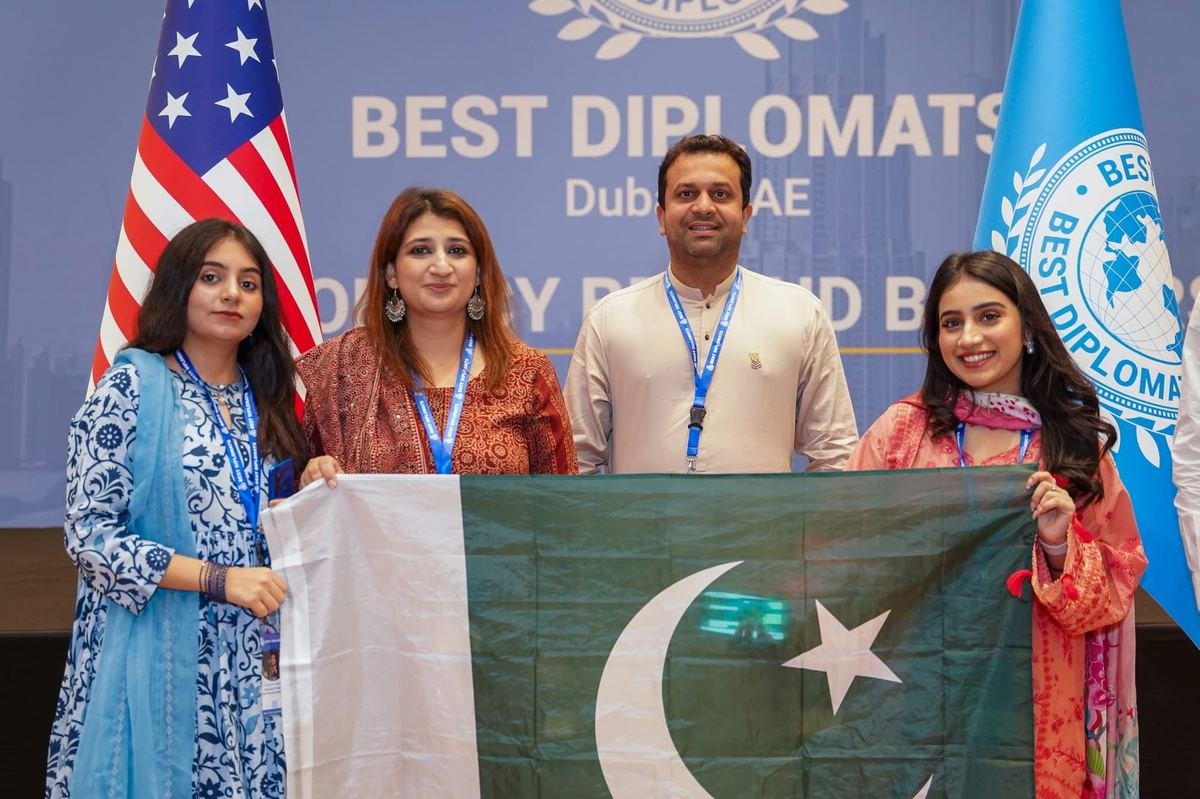
If you have spent any time researching international Model UN conferences from Pakistan, you have almost certainly run into the name Best Diplomats. It comes up in WhatsApp groups, on Instagram reels of students at the Burj Khalifa with sashes over their suits, and in conversations with MUN coordinators trying to figure out which conference is worth the airfare. Yet very little of what is online actually explains, plainly, what Best Diplomats is, how its judging works, what the awards mean on a CV, and whether it suits a Pakistani delegate over the alternatives.
This guide is the long version of that conversation. We have sent delegations to multiple Best Diplomats editions over the past several years, and the goal here is to help a Pakistani parent, student, or school coordinator decide with eyes open. There is praise and there is honest critique.
What Best Diplomats actually is
Best Diplomats is a youth diplomacy and Model UN conference series founded in 2017 and hosted by the International Forum for Diplomacy (IFP). It runs multiple editions per year across major international cities — most consistently Dubai, Kuala Lumpur, Bangkok, Istanbul and Doha, with periodic editions in other capitals. Across its full history, it has hosted delegates from more than 95 countries.
The audience is primarily youth and early-career professionals: a mix of high-school seniors (and some Year 10 and 11 students), university undergraduates, and young professionals in their early-to-mid twenties. A typical edition draws delegates from 50 to 90 countries, weighted heavily toward MENA, South Asia and Southeast Asia, with a steady and growing presence from Europe, Africa and the Americas.
That demographic is the single most important fact for a Pakistani family to understand. Best Diplomats is not a Harvard or Yale university-hosted academic conference run by undergraduates for high schoolers. It is a standalone international youth platform — closer in feel to a global summit than to an academic competition.
The format: what a typical Best Diplomats actually looks like
Editions almost always run four to five days. A typical schedule includes:
- Opening ceremony on Day 1 — keynotes from diplomats, ambassadors, or guest speakers; introductions of the secretariat; flag presentations.
- Multiple committees running in parallel for the next two to three days. Standard committees include the UN General Assembly (UNGA), UN Security Council (UNSC), UN Women, ECOSOC, the World Economic Forum, and rotating specialised bodies on disarmament, human rights, or climate.
- Cultural night — a non-negotiable part of the Best Diplomats experience. Delegations represent their countries through dress, food, music, or short performances. Pakistani delegations consistently make a strong impression here, and many delegates rate it as the most memorable session of the trip.
- Gala dinner — formal evening, networking-heavy, often used as the moment where delegates exchange contacts that turn into real friendships and collaborations long after the conference ends.
- Closing and certificates ceremony on the final day — awards announced, certificates handed out, group photographs.
Within committees, procedure follows the standard MUN flow that any prepared delegate will recognise: roll call, setting the agenda, opening speeches in the General Speakers' List, moderated and unmoderated caucuses, working papers, draft resolutions, amendments, voting bloc, and final voting. Position papers are usually required and submitted in advance.
If you have not yet attended an international Model UN, our step-by-step preparation playbook for your first international MUN walks through how to research a country, draft a position paper, and behave in committee — most of it applies directly to Best Diplomats.
The vibe: how Best Diplomats differs from HMUN, NMUN, and the Ivy circuit
This is the part that surprises most first-time delegates. Best Diplomats is genuinely different from the academic-style Model UN that schools in Pakistan are used to.
- Less hard-academic. The pace inside committee is real but more forgiving than HMUN. Chairs are generally more patient with delegates who are still learning procedure. Research expectations are serious but not Ivy-undergraduate-thesis level.
- More international networking. A larger share of the agenda is set aside for cultural exchange, gala dinners, and city tours. The relationships you build with delegates from Tunisia, Indonesia, Kazakhstan, Nigeria, or Egypt are part of the actual product.
- More inclusive of first-time delegates. A delegate who has only done one or two domestic MUNs in Pakistan can hold their own at Best Diplomats, especially with proper preparation. The same delegate at HMUN is likely to feel out of their depth in the first session.
- Cultural exchange is treated as content, not as a side activity. Cultural night is a flagship event, not a filler.
None of this makes Best Diplomats less serious. It makes it serious in a different register — diplomatic and youth-summit, rather than academic-competitive.
Judging criteria: what chairs are actually looking for
Across Best Diplomats committees, the judging matrix is reasonably consistent. Chairs evaluate delegates on roughly five dimensions:
- Research and country knowledge. Do you know your assigned country's foreign policy, its allies and rivals, its actual position on the agenda topic, and at least two or three real-world data points or treaty references you can use under pressure?
- Diplomacy and demeanour. Do you stay in-character as your country, even when the country's position is unpopular? Do you avoid personal attacks? Do you speak respectfully in caucuses?
- Negotiation and bloc-building. Can you build alliances during unmoderated caucus, draft compromise language, and bring smaller delegations into your bloc rather than steamrolling them?
- Position paper quality. The pre-conference written submission. Chairs read these. A clear, well-cited, country-accurate position paper sets the baseline for how you are perceived from Day 1.
- Speaking and procedural fluency. The General Speakers' List speech, moderated caucus interventions, and right-of-reply moments. Chairs are looking for clarity, structure, and the ability to engage with what other delegates have just said — not memorised speeches.
The honest version: Best Diplomats chairs vary. Some are extremely rigorous. Some are more lenient. The single best protection against an inconsistent chair is to be unmistakably prepared — a strong position paper, a country knowledge that is hard to challenge, and bloc-building behaviour that other delegates publicly endorse.
Award structure: what each award actually means
Best Diplomats hands out a recognisable suite of awards, presented at the closing ceremony with signed certificates. The typical hierarchy:
| Award | What it means | CV weight |
|---|---|---|
| Best Delegate | The single top performer in the committee. Combines research, speaking, negotiation and diplomacy at the highest level. | High. The headline award. |
| Outstanding Delegate | Just below Best Delegate. Typically one or two per committee. Strong on most criteria. | High. Reads almost as strongly as Best Delegate to admissions officers. |
| Honourable Mention | Recognised for consistent contribution and competence. Often three to five per committee. | Solid. Demonstrates that you held your own internationally. |
| Best Position Paper | Strongest pre-conference written submission in the committee. | Specifically valuable for delegates applying to research-heavy programmes (IR, law, public policy). |
| Best Diplomacy | Recognises the delegate who built the broadest, most respectful coalition — sometimes called Best Negotiator depending on the edition. | Strong, especially for delegates whose pitch is "team-builder" rather than "loudest voice". |
Every delegate also receives a certificate of participation, which on its own is a legitimate credential to list under "international experience" on a CV or personal statement. The named awards above are bonuses, not the only return on investment.
Cost ballpark: what a Pakistani family is actually paying for
Costs vary by edition, but the broad shape is consistent. Direct registration fees usually fall in the USD 400–700 range per delegate, depending on city and timing of registration. Then layer on:
- Visa fees and processing — varies by destination. Dubai, KL and Bangkok are the cheapest and most predictable for green passports; Istanbul and the rare US/EU editions are more involved.
- Flights — Dubai roughly USD 350–550 round trip from Lahore or Karachi; KL and Bangkok USD 500–800; Istanbul USD 600–900.
- Accommodation — usually 4–5 nights at the conference's host or partner hotel, between USD 80 and USD 180 per night depending on edition and room sharing.
- Meals, transport, gala-night attire, incidentals.
End-to-end, a solo Pakistani delegate going independently to a Dubai or KL Best Diplomats can expect to spend between PKR 600,000 and PKR 1,200,000 all-in. A PIFIS-handled package bundles registration, flights, accommodation, ground transport, supervision, and visa support, typically into a single quoted price. The bundled price is usually higher than rock-bottom DIY but materially lower than the same trip booked piecemeal once you account for visa rejections, missed early-bird windows, last-minute flight prices, and the time cost of a parent doing all the coordination.
For a full breakdown including how families budget across multiple conferences in a year, see the 7 best international MUN conferences for Pakistani students in 2026.
Who actually attends
A typical Best Diplomats has between 200 and 500 delegates, distributed across committees. The country mix shifts edition to edition, but a recurring pattern looks roughly like this:
- MENA, South Asia, Southeast Asia: the core, usually 60–70% of the room.
- Europe and Central Asia: a steady 10–15%, growing.
- Africa: 8–12%, with strong representation from Egypt, Nigeria, Morocco, Kenya.
- Americas: 5–10%, weighted toward US-based university students and Latin American delegations.
Age range skews 16 to 24, with the modal delegate being a 17 to 20 year-old high-school senior or first/second-year undergraduate. This is exactly the demographic that a Year 11, Year 12, A2, or first-year LUMS/NUST/IBA student fits into naturally.
Why PIFIS picks Best Diplomats for many of our delegations
We do not send every delegation to Best Diplomats — there are conferences where it makes more sense to go to HMUN, WorldMUN, or a UN-hosted youth summit. But Best Diplomats is in our regular rotation for four specific reasons:
- Visa accessibility for green passport holders. Dubai, Kuala Lumpur and Bangkok are the three easiest international destinations from Pakistan for a teenager. Visa rejection rates are low when paperwork is clean. Compare that to a US conference, where a B1/B2 visa for a 16-year-old can be a multi-month gamble.
- An inclusive culture that does not punish first-time international delegates. A delegate who has done two or three domestic MUNs at LGS, Aitchison, Beaconhouse or KGS can step into a Best Diplomats committee and contribute meaningfully from Day 1, with proper preparation. They will not feel like they have walked into a graduate seminar.
- Strong networking with regional youth. The relationships our delegates build with peers from the GCC, Indonesia, Malaysia, Turkey and Egypt are practically useful — for university applications, for internships, for career networks a decade later. This is harder to engineer at a US-hosted conference where the dominant peer group is American undergraduates.
- A credential that holds genuine weight on college applications and CVs. Counsellors at LUMS, NUST, IBA, FAST, and increasingly at US and UK universities recognise Best Diplomats as legitimate international experience. We discuss the broader value of conference credentials in our complete guide to Model UN for Pakistani students and parents.
What a 5-day Best Diplomats actually looks like, day by day
Day 1 — Arrival and opening ceremony
Most delegates fly in on the morning of Day 1 or the evening of Day 0. Hotel check-in, badge collection, briefing from the secretariat, and the opening ceremony in the late afternoon or evening. The opening usually features at least one ambassador or senior diplomat as keynote speaker. Cultural attire is encouraged. First night is informal — delegates meet committee-mates, swap WhatsApp numbers, scope out the room.
Day 2 — First full committee session
Roll call, setting the agenda, opening speeches in the General Speakers' List. Most committees spend Day 2 on broad framing — defining the problem, identifying blocs, signalling positions. Lobbying begins in earnest during unmoderated caucuses. By Day 2 evening, most delegates know roughly which two or three blocs are forming.
Day 3 — Working papers and bloc-building
The most intense day. Working papers are drafted, often through hectic small-group writing sessions during caucuses. Bloc leaders emerge. Strong negotiators consolidate alliances; less prepared delegates start to fade. Cultural night usually falls on Day 3 evening — it is a deliberate reset before the final day of substance.
Day 4 — Voting bloc and award ceremony
Working papers become draft resolutions. Amendments are debated. Voting procedure runs in the afternoon. Closing speeches, gala dinner in the evening, and the awards ceremony — usually announced after the gala in front of the full delegation. This is the night the photographs that end up on Instagram are taken.
Day 5 — Cultural day or departure
Many editions include an organised city tour or cultural excursion on Day 5: desert safari in Dubai, Petronas Towers and Batu Caves in KL, Grand Palace in Bangkok, Bosphorus cruise in Istanbul. Delegates whose return flights are later in the day usually join the tour; those flying out earlier head to the airport directly from the hotel.
Cultural and practical notes for Pakistani delegates
- Halal food. In Dubai, Kuala Lumpur and Doha, halal is the default and you will rarely have to ask. In Bangkok and Istanbul, the conference hotel typically arranges halal options, but it is worth confirming in advance. PIFIS-handled delegations always pre-clear this with the host hotel.
- Prayer arrangements. Hotels in all five cities accommodate prayer needs. Dubai, KL and Doha are seamless. The conference schedule does not pause for prayer, so plan to step out during transitions or longer caucuses; chairs are generally understanding when delegates handle this discreetly.
- Dress code. Western business formal during committee sessions — suits for boys, formal trousers and blazers or modest formal dresses for girls. National attire is encouraged at the opening ceremony and cultural night. Shalwar kameez or sherwani for boys, a formal kurta or modest dress shalwar kameez for girls reads beautifully and consistently wins compliments.
- Networking dinner expectations. Gala dinners involve mixed-gender seating and a fairly Western banquet format. There is no pressure to drink — non-alcoholic beverages are always available, and a meaningful number of delegates from MENA and South Asia abstain. The networking is the point, not the menu.
- Phone, WhatsApp, parents. Roaming SIMs or local data SIMs are easy to arrange in all five cities. Daily check-ins with parents are standard for our delegations and we structure them around the schedule.
For a fuller treatment of safety, supervision, prayer arrangements, and the cultural concerns Pakistani parents raise most often, our Pakistani parent's guide to international student travel goes deeper.
Honest critique: what Best Diplomats is not
We respect the conference enough to be honest about its limits.
- It is not as academically rigorous as HMUN, WorldMUN or NMUN. If your delegate is a senior MUN-er aiming for the most demanding intellectual environment, Best Diplomats will feel comfortable but not stretching.
- It will not carry the brand weight of Harvard or Yale on your CV by name alone. A "Best Delegate, HMUN" line reads stronger to an admissions officer at a US Ivy than "Best Delegate, Best Diplomats Dubai" — that is just brand reality. Best Diplomats is excellent international experience; HMUN is excellent international experience plus a brand halo.
- Judging consistency varies by chair. The same delegate performance can win Best Delegate in one committee and Honourable Mention in another. Strong preparation insulates against this but does not eliminate it.
- Accommodation quality varies by edition. Dubai and KL host hotels are reliably 4-star or better; Bangkok and Istanbul are usually solid; some smaller editions have used hotels that delegates rated as merely acceptable. PIFIS-handled trips upgrade where the default is below standard.
- It is not free, and the value depends on what the delegate puts in. A delegate who treats it as a tourism trip will get a tourism trip. A delegate who treats it as their first real international diplomacy platform will get a credential, a network, and a CV line that compounds.
Who Best Diplomats is right for — and who should look elsewhere
Best Diplomats is the right call for:
- First-time international delegates, particularly from Pakistani schools where one or two domestic MUNs is the baseline.
- Year 10 to first-year-undergraduate students looking for a meaningful credential without the visa risk of a US trip.
- Delegates whose strengths are diplomacy, networking and public speaking more than dense procedural mastery.
- Families who want a defined, well-handled package and predictable logistics.
Look elsewhere if:
- The delegate has already done two or three Best Diplomats or equivalent, and needs a more academically demanding environment — point them toward HMUN, WorldMUN, or NMUN-NY.
- The delegate is specifically chasing the Harvard or Yale brand on their CV.
- The family is unwilling or unable to commit to the full international travel cost — in that case, build domestic MUN credentials first.
Frequently asked questions
Is Best Diplomats a real, accredited conference?
Yes. Best Diplomats is a real conference series organised by the International Forum for Diplomacy (IFP), founded in 2017 and running multiple editions per year in cities including Dubai, Kuala Lumpur, Bangkok, Istanbul and Doha. It is not a UN-affiliated body, and there is no formal global accreditation system for Model UN conferences anywhere in the world. What it offers is a documented track record of more than 95 participating countries, signed certificates, and a consistent format that universities and employers recognise as a youth diplomacy credential.
Do colleges recognise Best Diplomats awards?
Yes. On a CV or college application, Best Diplomats functions the same way as any reputable international Model UN. A Best Delegate or Outstanding Delegate award shows demonstrated public speaking, negotiation and research skill against an international peer group. It will not carry the brand weight of Harvard's HMUN on its own, but admissions officers at LUMS, NUST, IBA, and US and UK universities read Best Diplomats awards as legitimate international youth diplomacy experience, especially when paired with a clear reflection in the personal statement.
How does Best Diplomats compare to HMUN?
HMUN is more academically rigorous, has a stronger university brand, harder competition, and a heavy emphasis on research depth and procedural mastery. Best Diplomats is more inclusive of first-time international delegates, prioritises networking and cultural exchange alongside debate, and is logistically far easier for Pakistani passport holders because of its Dubai, KL, Bangkok and Istanbul editions. Most delegates do not need to choose between them — they progress from Best Diplomats as a first international conference to HMUN, NMUN or WorldMUN later.
Which Best Diplomats edition should a Pakistani delegate pick?
For first-time international delegates with a Pakistani passport, the Dubai and Kuala Lumpur editions are usually the easiest fit: visa processes are well-trodden, halal food and prayer arrangements are straightforward, and flight times are manageable. Bangkok is a strong second choice. Istanbul is excellent for delegates who want a more European feel and are comfortable with a slightly more complex visa process. Doha works well for delegates already travelling through the Gulf.
Can a Year 10 student attend Best Diplomats?
Yes. The minimum age varies by edition, but Year 10 students (15–16 years old) are commonly accepted, particularly in Dubai and Kuala Lumpur, provided they travel with proper guardianship arrangements. Younger students are advised to attend a domestic Model UN first to learn procedure, and to travel as part of an organised delegation rather than solo. Best Diplomats is more inclusive of younger first-time delegates than most Ivy-hosted conferences.
Thinking about a Best Diplomats edition?
Talk to PIFIS about which edition fits your delegate, or join our flagship Youth Impacts 2026 delegation.
Get in touch