On the morning of 30 September 1947, just six weeks after Pakistan came into being, the country was admitted as the 56th member of the United Nations. The state itself was barely organised — government files were still being moved between Karachi and Delhi, refugees were still arriving by train and on foot, and the Foreign Office in Karachi had a handful of officers and one telephone. Yet within a year of independence, Pakistan had a permanent mission in New York, was speaking from the General Assembly rostrum, and had begun a diplomatic engagement with the UN system that has continued, almost without interruption, for nearly 80 years.
For students reading this — particularly those weighing whether international affairs is a career, or whether a Model UN delegation is worth the time and money — that history matters. Not because Pakistan's UN record is uncomplicated; it isn't. But because the country has produced an unusual number of consequential diplomats for its size and age, and because the institutions that built them are still there, still recruiting, and still very much open to a generation that decides early it wants in. This piece is the long version of that argument: a working history of Pakistan at the UN, the people who shaped it, and what it would take for the next generation to inherit it well.
1947: a state and a seat at the same time
Pakistan's accession to the UN was unusually fast. The General Assembly's First Committee approved its application on 25 September 1947; the full Assembly admitted it on 30 September. The first Permanent Representative was Mir Laik Ali, an industrialist-turned-diplomat who had been part of the Indian delegation to the UN earlier that year and crossed over after partition. He served only briefly — within months he was recalled to take up the post of Prime Minister of Hyderabad State — and was succeeded in early 1948 by Sir Muhammad Zafrulla Khan, who would become the defining figure of Pakistan's first quarter-century at the UN.
What that early generation did at the UN was, in effect, build a diplomatic doctrine while running the country. Kashmir went to the Security Council in January 1948 with Zafrulla Khan as Pakistan's lead counsel. The Palestine partition debate was already underway. Pakistan was simultaneously arguing the legal merits of plebiscite in Kashmir, opposing what it saw as imposed partition in Palestine, and trying to position a young Muslim-majority state as a credible voice on decolonisation more generally. The UN was where that voice had to be made — there was no other amplifier.
Sir Muhammad Zafrulla Khan: the diplomat behind the doctrine
Any honest history of Pakistan at the UN starts and probably ends with Zafrulla Khan. He served as Pakistan's first Foreign Minister from 1947 to 1954, led the country's UN delegation through some of its earliest battles, and then went on to a career at the UN itself that no other Pakistani has matched. In 1962-63 he was elected President of the UN General Assembly for its 17th session. From 1954 to 1961 and again from 1964 to 1973 he served as a judge of the International Court of Justice in The Hague, and from 1970 to 1973 he was President of the Court — the only Pakistani to hold that position, and one of a very small number of jurists from the developing world ever to do so.
Zafrulla Khan's reputation in international legal circles was substantial enough that his Kashmir address to the Security Council in January 1948 — which ran across several sittings — is still referenced in textbook treatments of self-determination. He spoke unscripted for hours, reportedly without notes for long stretches, and historians of the UN's early years tend to mention his style as much as his substance. For a country whose institutions were three months old, having a representative of that calibre at the founding of the UN's jurisprudence was not luck. It was, in retrospect, the single most useful piece of diplomatic capital Pakistan ever had.
The Security Council, again and again
Pakistan has been one of the more frequently elected non-permanent members of the UN Security Council in the organisation's history. The pattern is roughly once a decade. Approximate terms include:
- 1952–53 — the first Pakistani term on the Council, with Kashmir still on the agenda.
- 1968–69 — during the Vietnam War years and immediately before the 1971 conflict that produced Bangladesh.
- 1976–77 — Cold War proxy years, with Pakistan navigating between Washington and Beijing.
- 1983–84 — the Soviet occupation of Afghanistan, the moment when Pakistan's UN diplomacy was at its most consequential post-1948.
- 1993–94 — the Bosnia war, Somalia, Rwanda; a period in which Pakistan had to vote on hard cases involving Muslim populations and peacekeeping failures.
- 2003–04 — the Iraq invasion debate; Pakistan was one of the elected members watching the US-UK draft resolutions fail to clear the Council.
- 2012–13 — Syria, the Arab Spring, drone strikes; Munir Akram's successor Masood Khan represented Pakistan and held the Council presidency in early 2013.
- 2025–26 — Pakistan's most recent term, currently active at the time of writing.
Across these terms, Pakistan has held the rotating monthly presidency of the Council multiple times. That presidency is more procedural than political — you set the agenda for a month, chair the meetings, sign press statements — but it is also the highest-visibility chair in the UN system and a reasonable proxy for how seriously a country's mission is taken. Pakistan's missions have generally been considered competent and well-prepared, even when its underlying positions were contested.
The peacekeeping country
If Security Council membership is the visible part of Pakistan's UN record, peacekeeping is the larger but less photographed part. For long stretches across the 1990s, 2000s and 2010s, Pakistan was either the largest or among the top three contributors of uniformed personnel to UN peacekeeping operations worldwide. Pakistani troops have served in Bosnia, Somalia, Liberia, Sierra Leone, Sudan, South Sudan, the Democratic Republic of the Congo, Haiti, East Timor and the Western Sahara, among others. Total cumulative deployments since the 1960s are well above 200,000 personnel; Pakistan has lost more than 150 peacekeepers in the line of duty, with names listed at the UN's Dag Hammarskjöld memorial in New York.
This matters for two reasons that are not always obvious. First, peacekeeping gives Pakistan a real institutional foothold inside the UN Department of Peace Operations and the Office of Military Affairs, which means Pakistani officers rotate through senior posts at headquarters in a way that smaller troop contributors do not. Second, it underwrites the country's credibility on Council resolutions about peacekeeping mandates — Pakistan is one of a small number of states whose military has actually executed those mandates in the field, repeatedly, and that experience shows up in the way its diplomats negotiate the relevant text.
The Permanent Representatives: a short who's-who
Beyond Zafrulla Khan, a handful of Pakistani Permanent Representatives in New York have shaped the country's UN posture in lasting ways.
Sir Agha Shahi — Permanent Representative in the early 1970s, later Foreign Minister, generally regarded as the chief intellectual architect of Pakistan's "non-aligned but not unaligned" Cold War posture. He drafted significant portions of the country's nuclear non-proliferation position and spoke for Pakistan during the difficult 1971 General Assembly debates on Bangladesh.
Jamsheed Marker — a long-serving career diplomat who held the Permanent Representative role in the 1990s and was later UN Secretary-General Kofi Annan's Personal Representative for East Timor, where he helped negotiate the territory's transition to independence. Marker held more ambassadorial postings than perhaps any career diplomat in modern history.
Munir Akram — Pakistan's Permanent Representative from 2002 to 2008 and again from 2019 to the present. Known inside the UN system as one of the most experienced Pakistani diplomats of his generation, Akram has chaired the G77 group, the Economic and Social Council and several Council subsidiary bodies. His second tenure has coincided with Pakistan's 2025-26 Council term.
Maleeha Lodhi — Permanent Representative from 2015 to 2019, the first woman to represent Pakistan at the UN in New York. Earlier in her career she was Pakistan's High Commissioner to the United Kingdom (twice) and Ambassador to the United States (twice), and edited The News. Lodhi's tenure is also notable for her Kashmir-related interventions during the 2019 General Assembly session.
Other names worth noting include Iqbal Akhund, Inam-ul-Haq, Shamshad Ahmad, Abdullah Hussain Haroon and Masood Khan. Several Pakistani diplomats have also served as Vice-Presidents of the General Assembly during years when Pakistan held that rotating slot from the Asia-Pacific group.
The signature files: what Pakistan has consistently argued
Pakistan's positions at the UN have been remarkably stable across governments — military and civilian — for decades. Five files in particular show up year after year in the country's General Assembly statements and Security Council interventions:
- Kashmir. Pakistan continues to invoke the Council resolutions of 1948-49 calling for a plebiscite, raises the issue at the General Assembly's annual general debate, and maintains that Kashmir remains an unresolved item on the Council's agenda.
- Nuclear non-proliferation, but not the NPT. Pakistan, like India and Israel, is not a party to the Treaty on the Non-Proliferation of Nuclear Weapons. Its position at the UN has been to argue for non-discrimination — that any disarmament regime must apply equally to all nuclear-armed states — and against country-specific exceptions.
- Afghan refugees. Pakistan hosted what was, for several decades, the largest refugee population in the world — at peak roughly 3 million Afghans, with another roughly 1.5 million present at the time of writing. The country's UN diplomacy on refugees has consistently pressed for international burden-sharing.
- Counter-terrorism cooperation. Pakistan has been an active participant in the UN's counter-terrorism architecture — the 1267 sanctions committee, the Counter-Terrorism Executive Directorate, the Global Counter-Terrorism Strategy reviews — even when domestic and bilateral pressures around the same issue have been intense.
- The Muslim world's voice at the UN. Through the Organisation of Islamic Cooperation (OIC), of which Pakistan is a founding member from the 1969 Rabat summit, Pakistan has frequently led or co-led group statements at the UN on Palestine, Bosnia, Kashmir, Islamophobia and the rights of Muslim minorities.
You don't have to agree with every one of these positions to recognise that Pakistan, unlike many states of comparable size, has a genuine doctrine at the UN. The doctrine is debated at home and contested abroad, but it exists, and that is itself unusual.
Pakistan's diplomatic apparatus today
Behind the speeches at Turtle Bay sits a working bureaucracy. The Ministry of Foreign Affairs in Islamabad runs the Foreign Service of Pakistan (FSP), one of the elite occupational groups of the federal Central Superior Services. New entrants come through the annual CSS examination conducted by the Federal Public Service Commission, and successful FSP allocatees are then trained at the Foreign Service Academy in Islamabad — a residential institution near Margalla Hills that runs an intensive curriculum in international law, diplomatic practice, languages, economics and Pakistan studies before officers are posted abroad.
Pakistan currently maintains diplomatic missions in roughly 80 countries, with around 110 embassies, consulates and high commissions worldwide. The Permanent Mission to the UN in New York is one of three multilateral hubs, alongside the Permanent Mission in Geneva (which covers the WTO, Human Rights Council and disarmament conferences) and the Permanent Mission in Vienna (IAEA, UNODC). Officers typically rotate every three to four years between Islamabad and missions abroad, and ambassadorships are filled from a mix of career FSP officers and a smaller number of political appointees.
The next generation: what Pakistan actually needs
Talk to anyone who has worked inside the Foreign Office for a decade and you will hear a consistent diagnosis. The ceiling on Pakistani diplomacy is not the talent of the officers entering the service. It is the depth of the bench behind them — the analysts, the academics, the journalists, the legal experts, the climate negotiators, the trade specialists who feed substance into a diplomatic position before it ever leaves Islamabad. To strengthen that bench, the country needs young people who can do specific things well. Among them:
- Real fluency in English plus a working second international language — Arabic, French, or Mandarin most usefully. UN documents are produced in six languages; serious negotiation happens in two or three at a time.
- Genuine subject expertise, not generalist exposure. Climate negotiations, international trade law, conflict resolution, sanctions regimes, maritime law, and AI governance are all fields where Pakistan needs depth. Generalists are everywhere; specialists who can also write a position paper are rare.
- Exposure to international fora before professional life begins. Diplomats who have never operated outside their own country tend to defer to officers who have. Even brief exposure as a student — through an international Model UN, a summer programme abroad, a conference scholarship — measurably changes how a young Pakistani relates to the rest of the world.
- The habit of writing. Diplomatic work is essentially the production of clear, defensible, persuasive prose under pressure. The students who become useful diplomats almost universally wrote a great deal in school — papers, briefs, position documents, op-eds — long before anyone paid them to.
Model UN, in particular, is one of the few accessible on-ramps to this world that exists for Pakistani students. It teaches the procedural vocabulary, forces you to defend a position you didn't pick, rewards research over rhetoric, and puts you in rooms with peers from outside Pakistan. We've written a longer guide to that world: What is Model UN? A guide for Pakistani students and parents.
From MUN to FSP: the realistic path
The honest map looks roughly like this. It is not the only route into international affairs in Pakistan, but it is the most common one for students who get there.
- High school (Years 9–12). Active in MUN, ideally serving as chair or USG by senior year. At least one international conference — Best Diplomats, HMUN, WorldMUN, THIMUN — to break out of the local circuit.
- Undergraduate. A strong degree in international relations, political science, law, economics, or history from LUMS, NUST, IBA, FAST, Aitchison's college equivalent, or a foreign university. International House and debating society involvement on top of coursework.
- Graduate study. A serious master's-level credential is increasingly the norm for senior officers. Common destinations: LSE, Oxford, Cambridge, SOAS, Sciences Po, Tufts Fletcher, SAIS, Columbia SIPA, Georgetown SFS. Scholarships including Rhodes, Chevening, Fulbright and the Higher Education Commission's overseas scheme are the usual funding routes.
- The CSS-FSP exam. Sat in Pakistan, usually in the candidate's mid-to-late twenties. Successful FSP candidates spend nine to twelve months at the Foreign Service Academy before their first posting.
- The career. Three to four-year rotations. First postings tend to be junior desks at small missions; ambassadorships come twenty to twenty-five years in.
That is one path, and it is the most directly diplomatic one. There are several adjacent paths that produce equally serious international affairs careers without going through the FSP. Among them:
- The Pakistani think-tank route — Institute of Strategic Studies Islamabad (ISSI), Institute of Regional Studies (IRS), Institute for Policy Reforms (IPR), Pakistan Institute of International Affairs (PIIA), Centre for Aerospace and Security Studies (CASS).
- International civil service — UN Secretariat, UNDP, UNICEF, UNHCR, World Bank, IMF, ADB, IOM. The UN's Junior Professional Officer (JPO) and Young Professionals Programme (YPP) are the common entry points for Pakistanis under 32.
- International journalism and policy writing — Dawn, Geo, BBC Urdu, Al Jazeera, the Financial Times' Pakistan coverage, Foreign Affairs and Foreign Policy contributors.
- Academia — international relations departments at LUMS, NUST, Quaid-e-Azam University, and increasingly at foreign universities where Pakistani scholars hold permanent posts.
One reason we make a point of writing about admissions in our other essays — see why college admissions officers value international conference experience — is that the graduate degrees that feed these paths increasingly assume some demonstrated international engagement before the application. Model UN is not the only way to build that record, but for Pakistani students it remains the most accessible.
What it means to stand behind a Pakistan placard
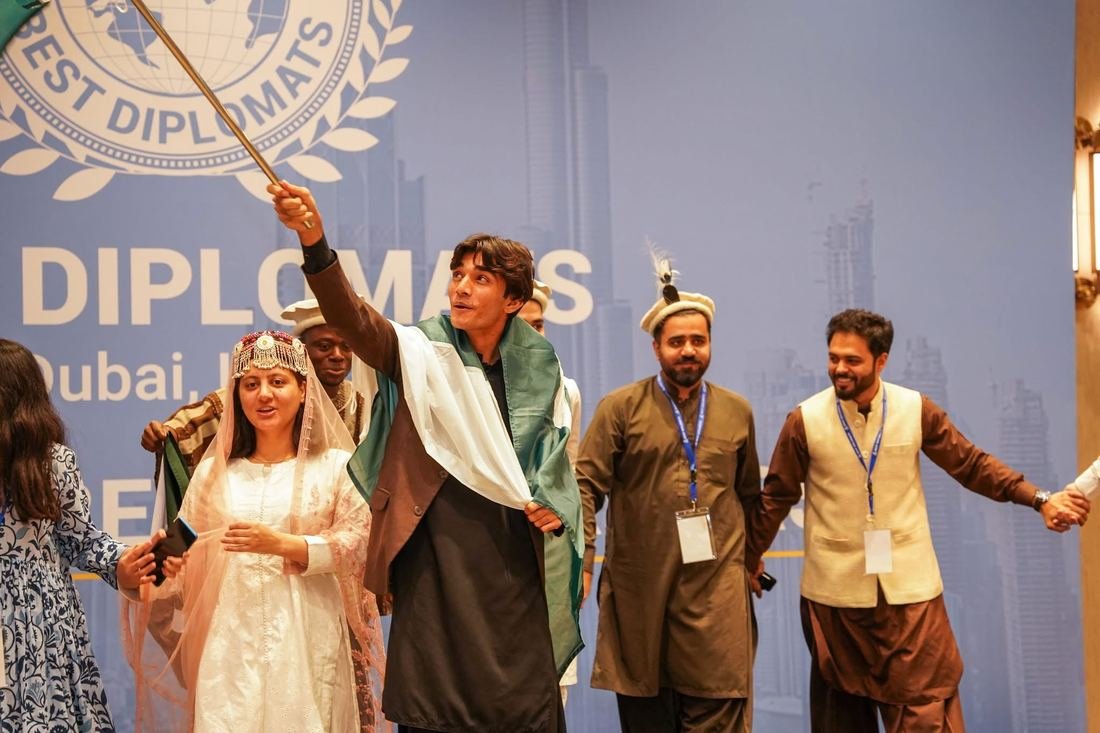
One of the things we underestimate, when we describe MUN in mechanical terms, is the weight of the placard itself. If you go to a conference like the Harvard MUN or Best Diplomats Dubai or WorldMUN and you draw the Pakistan delegation, you will spend three or four days with a card on the table in front of you that simply reads PAKISTAN. People in the room — chairs, fellow delegates, observers — see that card before they see you. For some of them, it is the first time they have spoken to anyone from Pakistan.
This is a small but real form of diplomacy. The country that exists in the room is the one you make visible. If you arrive prepared, write a strong position paper, speak coherently in committee, and stay polite under pressure, you have done something useful for Pakistan that has nothing to do with the resolution that gets passed. If you arrive unprepared or rude, you have done the opposite. Most delegates feel this within an hour of their first session. It is one of the things that distinguishes serious MUN from the more performative versions: the awareness that the country on the placard is, however briefly, your responsibility.
This is also why our delegations think carefully about which conferences are worth the travel — not every international MUN delivers the same kind of room. We've written about that selection problem in the seven best international MUN conferences for Pakistani students in 2026.
The longer arc
From Mir Laik Ali to Munir Akram, from Zafrulla Khan in 1948 to a 17-year-old delegate at HMUN in 2026, the line is not as straight as a brochure would have it. There were cold years. There were mistakes. There were moments — the 1971 General Assembly, the 2003 Iraq Council debate, the 2019 Kashmir interventions — when the country's diplomacy was stretched far past what its institutions could comfortably support. There were also moments when a single Pakistani jurist, in the right room, on the right day, raised the country's standing measurably. That is what individual diplomats can do, and that is why building them seriously matters.
PIFIS is one institution among several trying to contribute to the early end of that pipeline. We send Pakistani student delegations to international Model UN and diplomacy conferences because we believe the next generation of the country's diplomats, scholars, journalists and global citizens needs to start training, in small but real ways, before they ever sit a CSS paper or fill out an LSE application. The placard in front of them at age sixteen is the same placard they may sit behind at thirty-five. The work of becoming the kind of person who deserves to is roughly twenty years long, and most of it is unromantic.
Frequently asked questions
When did Pakistan join the United Nations?
Pakistan joined the United Nations on 30 September 1947, just six weeks after independence on 14 August 1947. It became the 56th member state. Pakistan's first Permanent Representative was Mir Laik Ali, who was succeeded shortly afterwards by Sir Muhammad Zafrulla Khan, the country's first Foreign Minister.
Who is Pakistan's current UN ambassador?
Ambassador Munir Akram has served as Pakistan's Permanent Representative to the United Nations in New York since 2019. This is his second tenure in the role; he previously served from 2002 to 2008. Pakistan's current term as a non-permanent member of the UN Security Council covers 2025-26.
How can a Pakistani student join the Foreign Service?
Pakistani citizens enter the Foreign Service of Pakistan (FSP) through the Central Superior Services (CSS) examination, conducted annually by the Federal Public Service Commission. Candidates must be Pakistani citizens between roughly 21 and 30 years old (with limited age relaxations), hold a bachelor's degree, and pass a written examination, psychological assessment and interview. Successful FSP allocatees then complete training at the Foreign Service Academy in Islamabad before their first overseas posting.
Has Pakistan ever held the UN General Assembly Presidency?
Yes. Sir Muhammad Zafrulla Khan served as President of the UN General Assembly during its 17th session in 1962-63. He remains one of the most accomplished international jurists Pakistan has produced and was also President of the International Court of Justice from 1970 to 1973.
What committees has Pakistan served on at the UN?
Pakistan has served approximately eight non-permanent terms on the UN Security Council (1952-53, 1968-69, 1976-77, 1983-84, 1993-94, 2003-04, 2012-13, and 2025-26). It has also served multiple terms on the Economic and Social Council (ECOSOC), the Human Rights Council, the Executive Boards of UNDP, UNICEF and UNESCO, and frequently chaired the G77 group of developing countries. Pakistan is a long-standing member of the OIC and a top-ranking troop contributor to UN Peacekeeping Operations.
Was Pakistan a founding member of the OIC?
Yes. Pakistan was one of the 25 founding member states of the Organisation of Islamic Cooperation, established at the inaugural summit of Muslim heads of state and government in Rabat, Morocco, in September 1969. Pakistan has hosted multiple OIC summits, most notably the 1974 Lahore summit.
Train the next generation of Pakistani diplomats
If you're a student or parent thinking about this path seriously, talk to PIFIS about Youth Impacts 2026 and our upcoming international delegations.
Get in touch